The Friday ROAR: A Simple Weekly Habit for Better Leadership
Many leaders end the week: inbox open, tasks half finished, and often a sense that next week is already behind before its begun! We could think of it as a discipline problem but it's really just missing routine.
I’ve for a long time done “Friday Reflections” but I came across this framework that many other leaders are finding useful, its the ROAR process, a framework created by Dermot Crowley, author of Smart Work: How to Boost Your Productivity in 3 Easy Steps (Wiley), and shared as Smart Tip 33 on dermotcrowley.com.au.
What is the ROAR process?
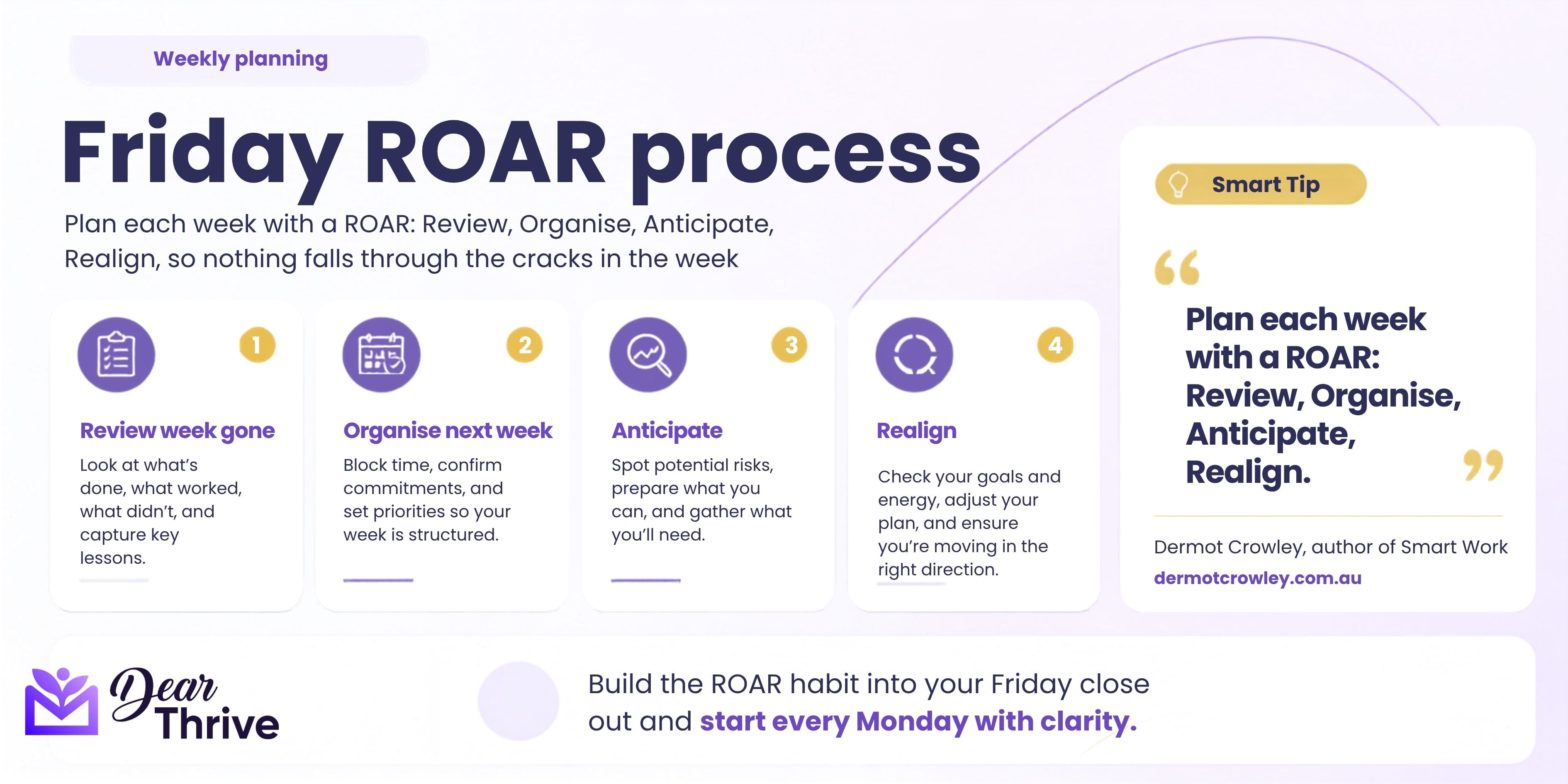
ROAR stands for Review, Organise, Anticipate, Realign. It's a short, structured Friday ritual that takes the mental load of "what did I miss" and "what's coming up" off your shoulders and onto paper (or your calendar). Done consistently, it becomes one of the more underrated leadership skills training habits you can build, because it protects your attention for the work that you should be prioritising.
Here's how each step works and YES you can structure this in your preferred LLM with this lens to keep you on track!
Review the week gone
Start by looking back before you look forward. Reschedule any unfinished tasks and actions, and scan your recent meetings for actions you haven't yet added to your calendar. Clear your inbox and your task list so nothing slips through.
Organise next week
Review your meetings and priorities for the week ahead. Block time for the work that matters, and factor in travel time so your calendar reflects reality, not wishful thinking.
Anticipate what's coming
Look three to four weeks out. Identify approaching deadlines, review any upcoming travel, and start or book in the proactive actions that get missed when you're only ever looking one week ahead.
Realign to what matters
Finally, check your priorities against your OKRs or your Top 3 goals, and review your larger projects. Schedule the actions, calls and meetings that keep those bigger pieces of work moving, rather than letting them get crowded out by whatever is loudest that day.
Why this matters for leadership development
A weekly ROAR isn't just a time management trick. It's a form of leadership development in miniature. Reviewing forces reflection. Organising builds discipline. Anticipating develops foresight, one of the more difficult leadership capabilities to grow. And realigning keeps your energy pointed at outcomes instead of noise.
Leaders I speak with often say, it's not that they don't know what matters, it's that their week fills up before they get to decide. A 15 minute Friday ROAR puts that decision back in your hands.
How to make the ROAR a habit
- Timebox it. Fifteen minutes on a Friday afternoon is enough. Treat it as a standing meeting with yourself.
- Keep it visible. Use whatever system you already trust, whether that's your calendar, a task app, or a notebook.
- Pair it with a trigger. Attach it to something you already do every Friday, like closing your laptop or your last meeting of the week.
- Review the pattern, not just the tasks. Every few weeks, notice what keeps slipping. That's usually where a leadership coach or accountability partner can help you address the underlying priority conflict, not just the symptom.
Build the habit with support
A weekly routine gets you organised. Leadership coaching gets you clear on what's worth organising for. If you're ready to build stronger habits around focus, priorities and leadership development, our team at Dear Thrive can help you put a framework like this into practice, backed by coaching that keeps you accountable to it.
Ready to strengthen your leadership habits? [Find a coach and book an introductory session] or [take the Leadership Capability Barometer] to see where to focus first.
Frequently asked questions
What does ROAR stand for in productivity? ROAR stands for Review, Organise, Anticipate, Realign. It's a weekly planning framework, popularised by author Dermot Crowley, designed to help professionals close out one week and set up the next with clarity.
How long should a Friday ROAR review take? Most leaders can complete a Friday ROAR in 15 to 20 minutes once it becomes a habit. The four steps are meant to be quick and structured, not a full planning session.
Is the ROAR process only for senior leaders? No. While it's a favourite among the leaders and executives we work with through leadership coaching, the framework works for anyone managing competing priorities, from individual contributors to founders.
How is ROAR different from a regular to-do list? A to-do list captures tasks. ROAR captures the whole picture: what's unfinished, what's next, what's coming in the next month, and whether your effort still matches your priorities.
#leadingthroughchange #coaching #professionaldevelopment #leadership #AIadvisor
Source: The ROAR framework (Review, Organise, Anticipate, Realign) was created by Dermot Crowley, author of Smart Work: How to Boost Your Productivity in 3 Easy Steps (published by Wiley), and shared as Smart Tip 33 via dermotcrowley.com.au. All credit for the original framework belongs to Crowley; this article applies it to a leadership coaching context.