Leading Through Change Alongside the Pace of AI: What Leaders Need to Know Now
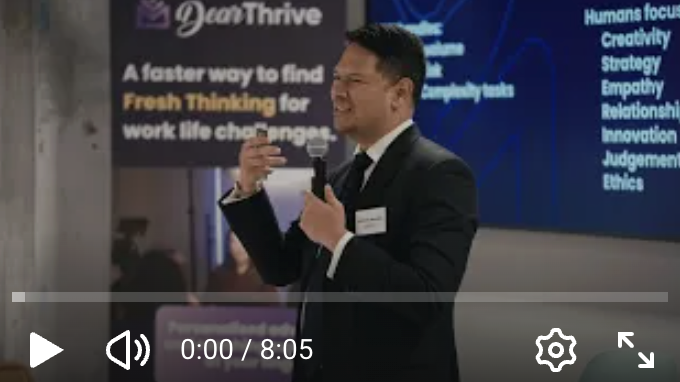
Featured Expert: Gladwin Mendez on AI Leadership and Organisational Change
Gladwin Mendez, Data & AI advisor presented at a Dear Thrive SPARK event on Leading Through Change Alongside the Pace of AI.
Gladwin's central argument is one every leader needs to hear: AI implementation is a people challenge and opportunity, NOT a technology problem.
Why AI Adoption Is Failing Many Organisations
The FOMO trap is real and risky. Many leaders are rushing AI adoption because competitors appear to be moving fast. But adopting AI to "keep up with the Joneses" without governance frameworks, risk controls, or human-in-the-loop oversight creates serious organisational exposure.
Speed without outcomes is no longer acceptable. With roles changing and investment in AI accelerating, the conversation must shift from theoretical exploration to practical, measurable results. Most organisations remain stuck at proof-of-concept or pilot stage. As Gladwin puts it: "It's time for delivery."
AI doesn't replace leaders, it changes what great leadership looks like. The executives navigating this well aren't just reacting to AI. They're strategically auditing their workflows, deploying AI to unlock growth, resilience, and innovation and future-proofing their relevance in the process.
The Real Leadership Challenge Right Now: The Experience Deficit
Today's leaders are being promoted faster, with less time to build judgment, while simultaneously being expected to absorb exponentially more information, much of which becomes obsolete quickly.
Gartner research on the future of leadership with AI confirms that AI accelerates this pressure, not alleviates it. The leaders who will thrive aren't just AI users, they're orchestrators of human-machine collaboration, enabling their teams and organisations to genuinely perform.
What Leaders Should Do Next: A Practical AI Leadership Framework
- Audit before you adopt: Identify low-risk, high-ROI use cases before deploying AI broadly. Innovation theatre helps no one.
- Build governance first: Ethical frameworks and human oversight must be in place before you scale.
- Invest in your own leadership development: AI fluency is now a core executive competency, not an IT ownership issue.
- Get personal support: The pressure of leading through this kind of disruption doesn't have to be carried alone.
Why Leadership Development Programs Aren't Enough
Leading through disruption - AI, workforce shifts, organisational uncertainty can't be learned through training programs and strategy decks alone. It requires hands-on experience, with expert advisory in your corner.
That's what Dear Thrive offers: personalised advisor sessions with practitioners like Gladwin who have lived experience at the intersection of AI strategy and leadership.
If this resonated, explore a conversation with Gladwin tailored specifically to where you are as a leader right now. That's the kind of support that bridges the gap between knowing what to do and actually doing it.
👉 Sign in to book a session with Connect with Gladwin on Dear Thrive
Frequently Asked Questions
What does it mean to lead through AI adoption?
Leading through AI adoption means taking responsibility for how your organisation integrates AI, not just technically, but culturally and strategically. It requires setting governance frameworks, maintaining human oversight, investing in your own AI fluency, and keeping people at the centre of every implementation decision.
Why is AI adoption failing in so many organisations?
Most AI adoption failures stem from a people and governance problem, not a technology one. Organisations rush to adopt AI driven by competitive pressure without clear use cases, risk controls, or human-in-the-loop oversight. The result is investment without outcomes, stuck at pilot or proof-of-concept stage with no measurable return.
What is the "experience deficit" in leadership and how does AI make it worse?
The experience deficit refers to leaders being promoted faster than they can build sound judgment, while simultaneously being expected to process more information than ever before. AI accelerates this pressure: it compresses timelines, increases information volume, and raises expectations, without giving leaders the time or support they need to develop real capability.
What should leaders do before adopting AI in their organisation?
Before adopting AI broadly, leaders should audit their existing workflows to identify low-risk, high-ROI use cases; put ethical governance and human oversight frameworks in place; build their own AI fluency as a core executive competency; and seek expert advisory support to navigate the strategic and human dimensions of implementation.
How is AI changing what good leadership looks like?
AI doesn't replace strong leaders, it changes the standard. The leaders navigating AI well are not just users of the technology; they are orchestrators of human-machine collaboration. They use AI to unlock growth and resilience while preserving the human judgment, trust, and relationships that no algorithm can replicate.
Where can I get personalised support on leading through AI change?
Dear Thrive connects mid-career and senior leaders with specialist advisors, including data and AI practitioners like Gladwin Mendez, for one-to-one advisory sessions tailored to your specific leadership context. You can book a session directly at dearthrive.com.