Your Employee Survey Is Telling You How People Feel. It's Not Telling You If Your Leaders Can Handle What's Next.

Every year, organisations pour time, money and good intentions into employee engagement surveys. eNPS scores get reported to the board. Pulse checks go out quarterly. Someone builds a dashboard. And then, six months later, the same issues resurface: disengagement, lack of clarity, feedback and development…..leading to churn, sub optimal productivity.
What Employee Surveys Are Built To Do
Engagement surveys are good at one thing: capturing sentiment at a point in time. Do people feel heard? Do they trust leadership? Would they recommend this as a place to work? These are good signals, and they matter.
But sentiment is a lagging indicator. By the time engagement scores dip, the underlying capability gap that caused it has usually existed for a while. Surveys tell you people are unhappy. They rarely tell you why, in a way that points to a fixable root cause, or what leadership capability needs to shift to change the trajectory.
The Gap: Feelings Without Capability
Most engagement tools measure how people feel about work. Almost none measure whether leaders and teams have the actual capability to navigate what's coming: AI adoption, restructuring, skills shortages, innovation, generational shifts in how work gets done.
That gap shows up in familiar ways:
📉 Engagement scores look fine, but leaders aren’t really clear about what to do next
🤖 AI tools get rolled out, but nobody has built the confidence or skill to use them well
🔄 High performers leave not because they're unhappy today, but because they can't see a credible path through business that is transitioning
🧭 Boards ask "are we ready for what's next" and HR has no data-backed answer, only a sentiment score
Engagement surveys weren't built to answer questions about capability, readiness or future fitness. That's not a criticism of the tools, it's simply outside their design brief.
How about measuring Leadership Capability and what’s needed for a Future Workforce?
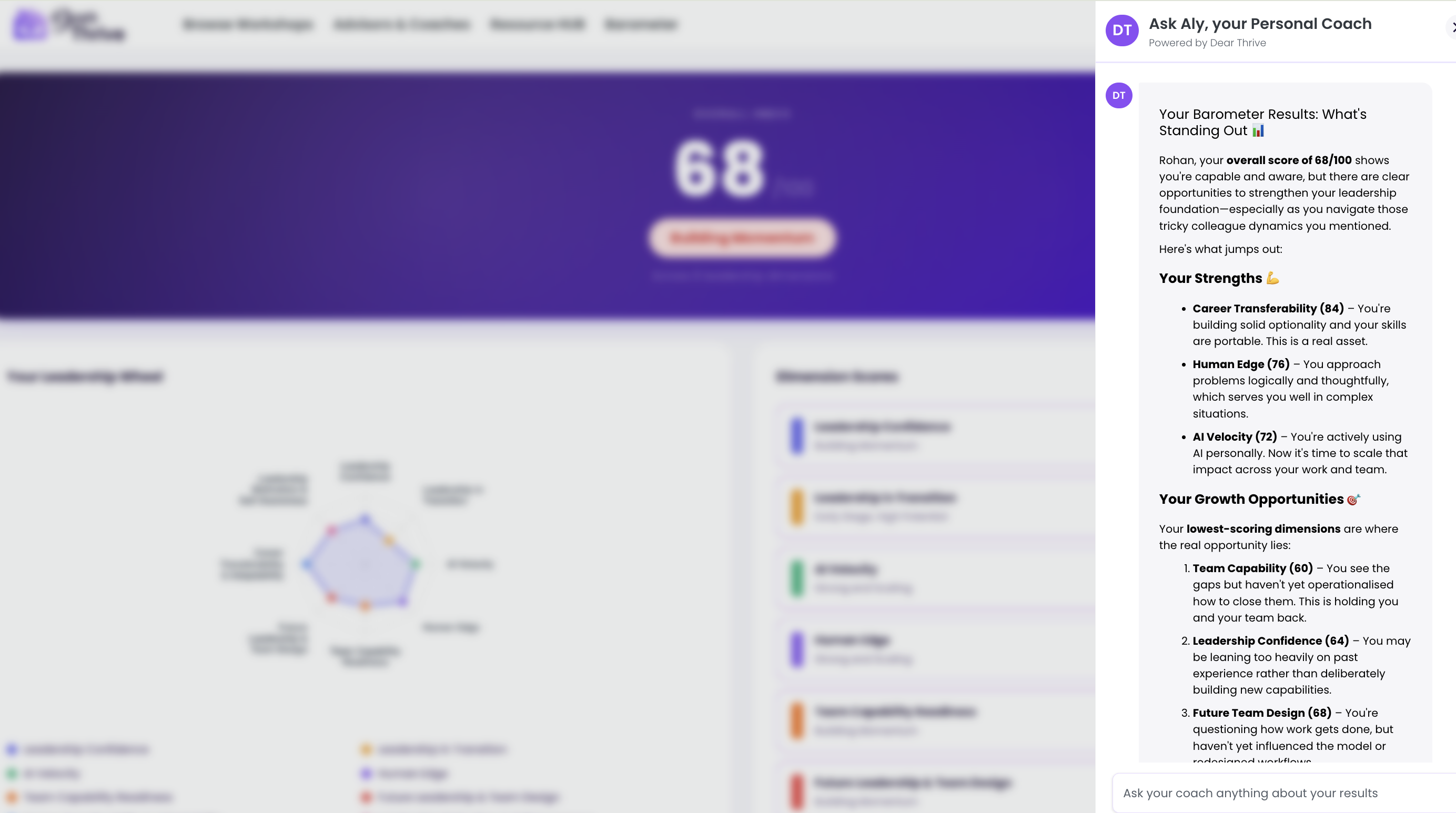
The Leadership Capability and Future Workforce Barometer™ was built to answer a different question: not "how do people feel right now," but "are our leaders and teams actually capable of leading through what's coming next."
It does this across eight dimensions, spanning things engagement surveys don't typically touch:
- Human Edge, the distinctly human capabilities that remain valuable as AI takes on more technical and repetitive work
- AI Velocity, how quickly and confidently your leaders are actually adopting AI, not just whether they've been to the latest webinar
- Team Capability and Future Team Design, whether your current team structure and skill mix can carry the organisation forward
- Leadership Confidence, Motivation and Transition, the internal readiness of leaders themselves to step up, stay engaged and move through change
- Career Transferability, how portable and future-proofed people's skills actually are
Each leader gets scored and benchmarked against a four-band system, from Early Stage High Potential through to Leading the Way, so the results are specific enough to act on, not just a number to report upward.
Why This Matters More Than It Did Two Years Ago
The pace of change inside organisations has outstripped the pace at which most engagement tools evolved. AI adoption alone has created a leadership readiness gap that traditional surveys simply weren't designed to see. You can have strong engagement scores and still have leaders who are out of their depth.
The Barometer doesn't replace your engagement survey. It answers the question your engagement survey was never built to ask: are the people leading your organisation equipped for what's ahead, and where specifically do you need to invest to close that gap.
If you're relying on engagement data alone to tell you whether your leadership bench is future-ready, it's worth asking what you might be missing. Get in touch to find out how to benchmark your leaders and support your programs for “where to next”.
Complete the Leadership Capability and Future Workforce Barometer
Frequently Asked Questions
What's the difference between an employee engagement survey and a leadership capability assessment? An engagement survey measures how people feel about work right now, things like trust, satisfaction and likelihood to stay. A leadership capability assessment like the Barometer measures whether leaders and teams have the skills and readiness to navigate future change, including AI adoption and workforce transformation.
Why don't engagement scores predict leadership readiness for AI? Engagement scores capture sentiment, which is a lagging indicator. A team can report high engagement today while its leaders lack the confidence, skills or team design needed to adopt AI effectively. These are two different data sets, and most organisations only collect one of them.
What does the Leadership Capability and Future Workforce Barometer measure? It scores leaders and teams across eight dimensions: Human Edge, AI Velocity, Team Capability, Future Team Design, Leadership Confidence, Leadership Motivation, Leadership Transition and Career Transferability, then benchmarks results against a four-band scoring system.
Should we run the Barometer instead of our engagement survey? No. They answer different questions and work best together. Engagement surveys track sentiment over time; the Barometer identifies specific capability gaps and gives HR and boards a data-backed answer to "are we ready for what's next."