Australia needs more leaders. Are they ready?
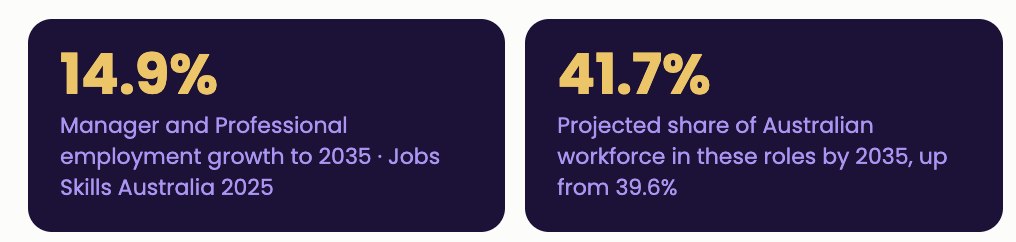
Jobs and Skills Australia published their Employment Projections to 2035. The Manager and Professional occupation groups, the people who run teams, make decisions, and set direction, are projected to grow by 14.9% over the next decade. That's 279,600 new management roles added to the Australian economy by May 2035. Managers and Professionals already account for 39.6% of total Australian employment, and that share is projected to rise to 41.7% by 2035 with Victoria and ACT leading the charge. The demand for leadership is growing, not easing.
Although 6 months feels more like 6 years in “AI years”, Jobs and Skills Australia also released a Gen AI Transition Report, in August 2025. The headline finding was that Gen AI is more likely to augment human work than replace it. But the finding underneath that one is the more important one for leaders. Jobs and Skills Australia concluded that what Australia's workforce needs, urgently, is both digital literacy and higher-order human skills simultaneously. Critical thinking, communication, adaptability, and the ability to work alongside AI tools. Not one or the other. Both.
We naturally compared this data to Dear Thrive’s Leadership Capability Barometer.
What the leadership capability data shows
At this point in time we had almost 200 leaders across Australia, New Zealand and Asia Pacific complete the Barometer, a diagnostic measuring eight capability dimensions for leaders navigating AI, rapid change, and rising expectations.
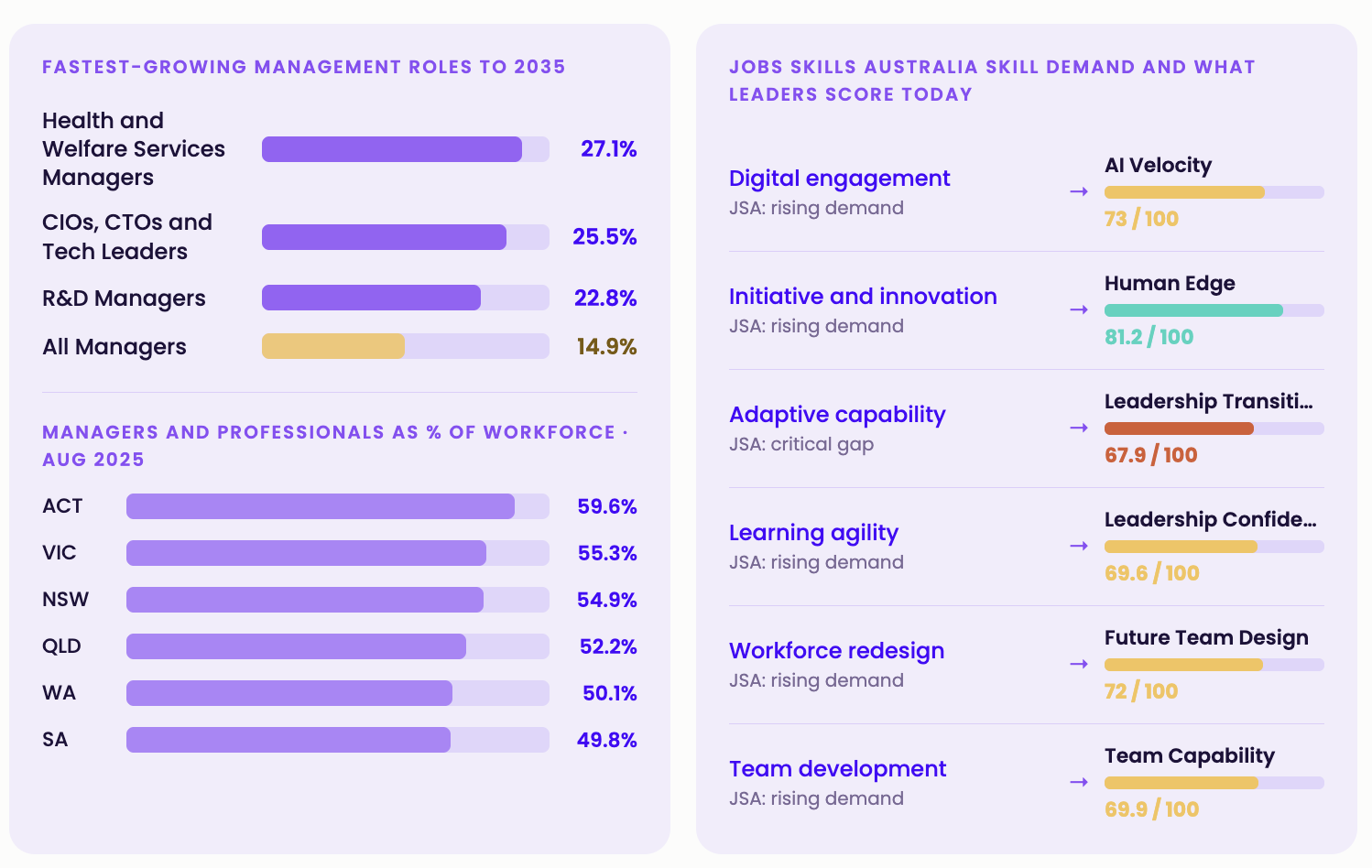
Human Edge measures creative thinking, decision-making under ambiguity, and the capabilities hardest for AI to replicate. It averages 81.2 out of 100. Leaders are strongest here. This matters beyond the Barometer: Price Waterhouse Cooper's 2026 AI Jobs Barometer found that in the most AI-exposed roles, new tasks are 2.5 times more likely to require human-intensive skills, including empathy, creativity, and leadership, alongside technical expertise. [1]
AI Velocity measures whether leaders integrate AI into complex workflows, evaluate outputs critically, and can measure the impact of their AI usage. It averages 73.0, which puts the average leader in the "Strong and Scaling" band. But 37% sit below 70, still experimenting rather than embedding, and 12% score below 50. They haven't meaningfully started.
The tension between those two numbers is interesting. Leaders are strong at what the market says will remain most valuable. They are behind on the skills that the market is now urgently demanding alongside that strength.
The AI and leadership skills gap: knowing vs doing
56% of leaders identified AI and Technology literacy as their top capability priority for the next three years. Of those same leaders, 43% score below 70 on AI Velocity. They know the gap exists. They are not closing it.
This is not a Barometer-specific finding. EY's Australian AI Workforce Blueprint, based on a national survey of 1,003 workers published in August 2025, found that 68% of Australian workers now use AI, but only 35% have received any formal AI training from their employer. One in four Australian workers are not permitted to use AI tools at work at all. [2]
The term now is “shadow use”. Jobs and Skills Australia’s research found that a significant share of AI adoption in Australia is individual-led: workers picking up tools on their own, without organisational frameworks or structured pathways. It shows up in Dear Thrive’s data too: leaders score themselves on AI confidence while operating largely outside any formal development support.
What no one is talking about
Leadership Transition is the lowest-scoring dimension in the Barometer at 67.9, sitting below AI Velocity, below Team Capability, below every other measure.
This dimension asks leaders: does leadership feel harder than it used to? It measures whether leaders can balance their own output with their teams and stakeholder demands, and, critically, whether the support available to them is keeping pace with what the role now requires.
Jobs and Skills Australia dedicates an entire section of the Gen AI report to the pace of change and adaptive capabilities as a central workforce challenge. The pressure is visible at the top too. PwC's 2026 CEO Survey of 108 Australian CEOs found that transforming fast enough to keep up with AI is their number one concern, cited by 58% of respondents. [3] Our data shows the leaders responsible for managing that transition are scoring lowest. C-suite leaders score 60.7 on Leadership Transition, lower than every other role level. The higher the role, it seems the less confident.
Leadership development in Australia: what the market demands, what leaders deliver
Jobs and Skills Australia's projections show the strongest management growth in Health and Welfare Services Managers (27.1% over the decade) and technology and digital leaders, including CIOs and CTOs (25.5%). Both require the kind of blended capability the Barometer measures: digital fluency applied through human-centred leadership in complex, fast-moving environments.
Yet the gap between ambition and delivery is wide. PwC's 2026 CEO Survey found only 14% of Australian companies are seeing revenue gains from AI, compared to 30% globally. Only 28% of Australian CEOs believe their current AI investment is sufficient to meet their goals. [3]
Our Future Team Design dimension measures whether leaders are structuring work for a blended human and AI workforce and developing people for future roles rather than current ones. It averages 72.0. Three in four leaders do not score in the Leading the Way band. Most are not yet designing their teams for the environment that is already arriving.
What this means for a leadership development program
Jobs and Skills Australia Atlas is free and public tool. Any people leader or CEO can look up the demand projections for their sector and region. What they cannot find in Atlas is whether their leaders are ready to meet that demand.
The question being asked at a national level is: are we ready?
Get your personal answer by completing the Leadership Capability and Future Workforce Barometer.
Q: What is the Dear Thrive Leadership Capability Barometer?
A: The Dear Thrive Leadership Capability Barometer is a free diagnostic tool that measures leadership capability across eight dimensions: Human Edge, AI Velocity, Team Capability, Future Team Design, Leadership Confidence, Leadership Motivation, Leadership Transition, and Career Transferability. It takes approximately eight minutes to complete and provides an individual score and personalised recommendations. It is available at dearthrive.com/barometer.
Q: What are the fastest-growing management roles in Australia to 2035?
A: According to Jobs Skills Australia's Employment Projections 2025, Health and Welfare Services Managers are projected to grow by 27.1%, technology and digital leaders including CIOs and CTOs by 25.5%, and the overall Manager and Professional group by 14.9% to May 2035.
Q: Why do Australian leaders score low on AI capability?
A: The Dear Thrive Leadership Capability Barometer (September 2026, n≈200) found that 37% of leaders score below 70 on AI Velocity, meaning they are experimenting with AI tools but not yet integrating them into complex workflows. EY's Australian AI Workforce Blueprint (August 2025) found that while 68% of Australian workers use AI, only 35% have received formal training, and one in four are not permitted to use AI tools at work.
Q: What does Jobs Skills Australia say about AI and leadership skills?
A: Jobs Skills Australia's Gen AI Transition Report (August 2025) concluded that generative AI is augmenting rather than replacing work, and that Australia urgently needs both digital literacy and higher-order human skills simultaneously, including critical thinking, communication, and adaptability.
References
[1] PwC Australia, 2026 AI Jobs Barometer: Demand for AI skilled workers doubles, human skills on top, June 2026. http://pwc.com.au/media/2026/2026-AI-Jobs-Barometer.html
[2] EY Australia, EY Australian AI Workforce Blueprint, August 2025. http://ey.com/en_au/newsroom/2025/08/new-ey-survey-most-australians-use-ai-at-work-but-few-feel-supported-by-leadership
[3] PwC Australia, 29th Global CEO Survey: Australia's Growth Imperative, January 2026. http://pwc.com.au/media/2026/pwc-australia-ceo-survey-2026-confidence-surges.html
[4] Jobs and Skills Australia, Employment Projections 2025 (to May 2035), December 2025. http://jobsandskills.gov.au/data/employment-projections
[5] Jobs and Skills Australia, Our Gen AI Transition: Implications for Work and Skills, August 2025. http://jobsandskills.gov.au/studies/generative-artificial-intelligence-capacity-study
[6] Jobs and Skills Australia, Australian Labour Market for Migrants, August 2025. http://jobsandskills.gov.au/publications
[7] Dear Thrive, Leadership Capability Barometer, September 2026 (n≈191, Australia, New Zealand and Asia Pacific). dearthrive.com/barometer